


Authors

Table of contents
In this article, discover…
Construction is rapidly shifting from physical delivery towards data-driven engineering. Challenges around buildability, structural integrity, installation sequencing, cost control, embodied carbon, and long-term asset performance are increasingly being solved using software long before the construction itself begins.
This shift is being driven by some of the biggest pressures facing the sector. Construction operates on tight margins, ongoing labour shortages make traditional manpower-heavy delivery models unsustainable, and stringent ESG standards and decarbonisation targets (like PAS 2080) demand additional tracking of embodied carbon from inception. As a result, solutions uncovered from digital engineering are becoming key drivers of construction innovation, and as projects become more complex, these new technologies are creating new opportunities for R&D.
Construction is becoming a software-led industry
The construction industry’s traditional focus on physical, on-site execution is being reframed around computational prep-work. With tight commercial margins, contractors and consultancies must mitigate risk and eliminate rework early. At the same time, businesses are under pressure to reduce costs and improve the recoverability of projects. Lastly, severe labour constraints mean scaling project delivery can no longer rely solely on increasing headcount. Digital engineering addresses these pressures directly by shifting risk upfront. Some examples include…
Design for Manufacture and Assembly (DfMA)
Off-site fabrication requires components to be designed to exact tolerances in controlled factory environments before delivery, turning site assembly into a standardized, “plug-and-play” process.
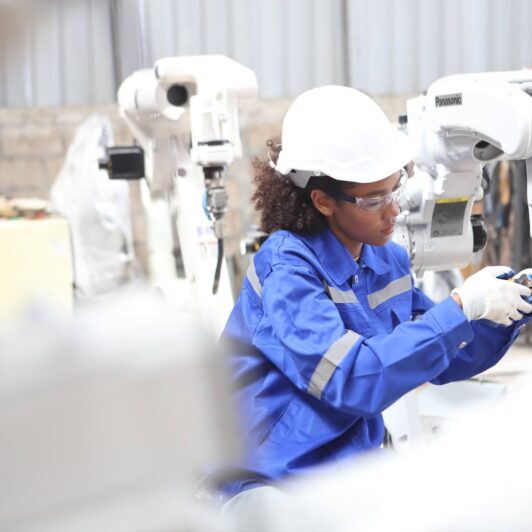
Robotics and automation
Automated tooling and robotic fabrication in off-site facilities execute complex assembly tasks that previously demanded large site teams.
Early carbon optimisation
Integrated digital models allow project teams to evaluate material choices and structural configurations against lifecycle carbon metrics early in the design stage.
For executive leadership, the challenge has evolved from balancing capital expenditure against physical assets to treating software, data platforms, and custom algorithms as core enterprise assets.
BIM was the foundation, but it was only the beginning
Building Information Modelling (BIM) was an important starting point for this transformation.
Originally, BIM was largely viewed as a 3D design tool. Today, it has evolved into the central nervous system for interdisciplinary engineering. Beyond spatial coordination, modern CDEs (Common Data Environments) are increasingly driven by regulatory imperatives, such as the legal requirement to maintain an immutable “Golden Thread” of building safety data from design through to operations.
However, off-the-shelf BIM platforms quickly hit functional limits when managing complex data centres, modular infrastructure, or nuclear facilities. When open data standards like IFC or COBie fail to convey complex, discipline-specific engineering metadata, firms are forced to build proprietary data pipelines. The core technical challenge shifts from operating software to engineering data interoperability, developing custom APIs and middleware that resolve fundamental data schema incompatibilities.
From 3D modelling to integrated engineering
Modern BIM and digital engineering environments can incorporate several different technologies and processes. Federated models combine multiple distinct disciplinary models into a single unified view. This allows teams to identify and resolve spatial issues between different engineering disciplines much earlier.
4D sequencing adds time to the model, allowing teams to visualise how construction should progress. 5D modelling goes a step further by integrating cost information, helping teams understand how expenditure changes throughout the construction sequence. This provides a much more detailed view of the project. Teams can understand what the physical reality of the project should look like at different stages, when subcontractors need to be engaged and when additional funding will be required.
A Common Data Environment (CDE) provides the underlying information environment. It acts as a single source of truth for collecting, managing and disseminating project information, reducing the risk of teams working in silos. This is particularly important on complex projects, where decisions made by one discipline can have significant consequences for another.
Data interoperability is therefore becoming increasingly important. Different companies and disciplines use different software systems, and there is rarely a single software solution that can handle everything required for a major engineering project. The challenge becomes: how do you get those systems to speak to each other?
The technical challenge of making systems speak
Interoperability can sound straightforward, but on a complex engineering project it can involve significant technical challenges. Different systems may use different data structures and may not naturally understand the information being produced by another platform. This can require the development of middleware that allows systems to communicate with each other, or APIs that enable different software environments to exchange information. That interaction between engineering requirements and software capability is becoming a significant source of innovation within construction.
AI is changing how engineering decisions are made
Artificial Intelligence in construction has progressed beyond administrative task automation into high-value engineering decision support. This is particularly relevant as the industry looks to standardise non-traditional construction approaches such as modular construction and DfMA. AI can support predictive risk analysis, using historical data to anticipate bottlenecks and optimise project schedules. It can support design optimisation, using parametric tools to rapidly configure different design iterations and assess their buildability or potential carbon impact.
It is also transforming clash detection. Historically, different trades or engineering functions might only identify conflicts once construction had progressed to a certain point. Now, project teams can sit around the table before construction begins and identify how one engineering decision affects another. For example, moving a structural beam may affect a fire engineering strategy or the installation requirements of another discipline. AI-assisted clash detection can help identify these installation conflicts digitally before the project reaches site.
Can engineering knowledge be codified?
However, the interesting technical challenge with AI is whether nuanced engineering knowledge can be codified into a parametric system. Engineering decisions often depend on highly specific variables. An experienced structural engineer considers dozens of interdependent variables simultaneously, such as span lengths, skew angles, soil-structure interactions, and local supply chain constraints.
To translate that collective knowledge into software, the dependencies must be codified into a parametric system capable of generating viable concept designs. This is where AI, software development and engineering knowledge converge, requiring close technical collaboration between structural engineering leads and software developers.
Testing digital models against real-world conditions
There is also a fundamental question around accuracy and reliability. AI and other digital tools may generate a theoretical solution, but that solution still needs to work in the real world. Construction businesses are therefore testing theoretical models against site-specific reality capture data. The more digital systems are used, the more important it becomes to understand whether their outputs accurately reflect real-world project conditions. This creates an ongoing feedback loop between the digital model and physical reality.
The technology may be able to generate a solution, but engineers still need to understand whether that solution is technically viable when exposed to the specific conditions of the project. That process of testing, refining and improving the technology is an important part of where genuine technical challenges can arise.
Digital twins are extending innovation beyond construction
Digital twins take this development beyond the construction phase. They effectively bridge the gap between construction and the long-term operational lifecycle of an asset, transforming physical builds into living digital assets. Instead of a digital model being completed when the construction project finishes, a digital twin can continue to evolve alongside the physical asset. This can involve integrating…
- Live operational data
- IoT sensors
- Reality capture data
- Performance modelling
- Asset information
- Predictive maintenance data
By linking the physical structure to a live computational twin, asset owners and facility managers ingest real-time operational data via embedded IoT sensor networks and ongoing reality capture.
Using sensors to understand real-world performance
Sensor integration is already creating new opportunities to understand how physical assets behave. For example, sensor technology can provide much earlier insight into the strength development of concrete. Traditionally, engineers might assess concrete strength at defined intervals, such as seven, 14 and 28 days. Sensor technology can instead provide information from much earlier in the process, allowing teams to begin predicting how the strength of the concrete will develop. It changes what engineers can understand about the material while the construction process is still underway.
Modelling the uncertainty of the real world
Digital twins can also be used for performance modelling. Instead of simply designing a structural member for a particular lifespan, businesses can model how it may behave over decades under different environmental stresses. Doing so, informs a more accurate predictive maintenance strategy, often enabling maintenance requirements to be mapped out much further into the asset’s operational life.
However, when a digital twin is scaled across a large infrastructure programme, the underlying challenge is accurately modelling real-world physics. The physical world is not static or entirely predictable. A digital twin therefore needs to account for these uncertainties, such as the environmental stresses above, rather than simply reproducing a static model of the asset. This is another area where businesses may need to push beyond what existing off-the-shelf products can provide.
Where does R&D happen in software-led construction?
The increasing role of software in construction raises an important question for businesses claiming R&D tax relief: where does routine software configuration end and qualifying R&D begin?
For Innovation Directors, CTOs, and Finance Leaders, the convergence of software development and structural engineering introduces major commercial opportunities, specifically regarding R&D Tax Relief.
Under international standards (such as the OECD Frascati Manual) and national tax authority guidelines (e.g., HMRC in the UK), routine software deployment or standard BIM modelling does not qualify as R&D. Qualifying activity arises exclusively when teams seek an advance in overall science or technology by resolving technological uncertainty that cannot be readily solved by a competent professional in the field.
| Category | Routine Implementation (Non-Qualifying) | Qualifying R&D Activity |
| Software & APIs | Purchasing, configuring, or licensing off-the-shelf BIM, CDE, or enterprise platforms. | Developing bespoke middleware or custom APIs to translate incompatible data schemas without losing engineering data integrity. |
| Parametric Design | Running standard, pre-packaged automation scripts (e.g., basic Dynamo or Grasshopper scripts). | Codifying complex, multi-variable engineering rules (e.g., skew angles, dynamic loading, soil interactions) into proprietary generative design algorithms. |
| Site Operations | Using commercial drone software for standard photographic progress reports. | Building custom algorithms to process messy, high-density point clouds into automated BIM-clash updates. |
| Digital Twins | Displaying static 3D models alongside isolated, non-integrated IoT telemetry dashboards. | Building predictive, bi-directional data pipelines that model real-world physical material degradation under non-linear environmental stresses. |
Bespoke integration can create technological uncertainty
A business may need to develop its own integration layer to allow different digital systems to communicate, especially on major infrastructure projects. This could involve developing middleware, creating APIs or developing new approaches to how different data structures are exchanged and interpreted.
In this development process, the business may need to undertake a systematic, investigative and analytical process to determine how complex engineering information can be transferred between systems in a way that works reliably. This can create technological uncertainty that needs to be resolved through development and testing.
Codifying site-specific engineering knowledge
The development of proprietary parametric design tools can present another potential area of R&D. Complex engineering knowledge needs to be translated into rule-based algorithms that can account for site-specific dependencies.
The collaboration between structural engineers, fabricators and software developers is critical to determine how engineering principles can be encapsulated within a digital system. The technical uncertainty lies in whether that knowledge can actually be translated into an algorithm capable of producing a technically viable outcome.
The future of construction is both physical and digital
The construction industry is becoming software-led because the challenges it faces increasingly require digital solutions. The future of construction is both physical and computational. Tight margins, labour constraints, regulatory requirements like the Golden Thread, and aggressive decarbonization goals mean that competitive advantage no longer belongs solely to those with the largest fleets or workforces. True market leadership belongs to firms that integrate software architecture into their core engineering delivery models.
AI is changing how engineering decisions are made. Digital twins are connecting construction with long-term asset management. And the need to integrate these technologies is creating new challenges around interoperability, data, engineering knowledge and real-world physical behaviour.
For construction and engineering businesses, this means innovation can no longer be viewed as something that happens only on site. It can happen in the software architecture, the engineering methodology, the integration between systems and the algorithms being developed to make complex projects possible.
Recognising where custom software development, system integration, and data codification cross the threshold into technological advance is essential. Not only for successfully delivering complex projects, but also for capturing the financial and tax benefits of enterprise innovation. Ayming works alongside leading construction, civil engineering, and specialist consultancies to identify and document qualifying R&D activity across both site-based engineering and software-led digital innovation.